
Latest News
Newsroom
2022-12-05
Canada: A Rising Leader in North America's Plastic Reduction Efforts
|
Starting from April 2020, Vancouver took the lead by gradually banning plastic bags, straws, and polystyrene food containers, becoming Canada’s first city to implement large-scale plastic reduction policies. Shortly afterward, in October of the same year, the Canadian government announced it would impose a nationwide ban by the end of 2021 on six categories of single-use plastics—such as straws, stirrers, plastic bags, plastic containers, and plastic cutlery—that are notoriously difficult to recycle. However, due to the COVID-19 pandemic, this initiative was temporarily put on hold amid public health concerns. It wasn’t until June 20, 2022, that Canada’s Minister of Environment and Climate Change, Steven Guilbeault, along with Health Minister Jean-Yves Duclos, officially confirmed at a press conference in Quebec City that the outright ban on single-use plastic bags, straws, and food containers for takeout—including disposable utensils—would take effect starting December of that year. Additionally, the government further tightened its stance by prohibiting the manufacture and import of these harmful single-use plastics altogether. With this ban taking effect, Canada expects to reduce more than 1.3 million tons of hard-to-recycle plastic waste over the next decade—equivalent to filling 1 million garbage bags with plastic, significantly cutting down on environmental harm! |
|
|
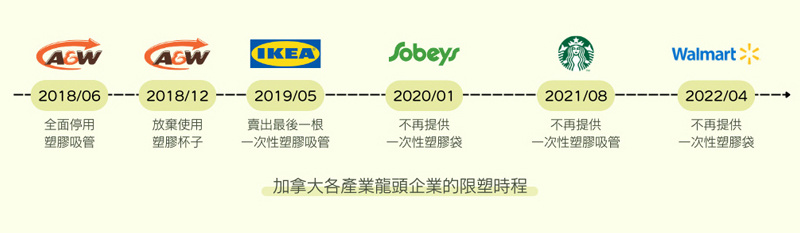
On the other hand, even before the Canadian government launched a series of initiatives to reduce plastic use, many businesses had already quietly taken steps on their own sustainability journeys. For instance, Canada’s popular fast-food chain A&W completely phased out plastic straws as early as June 2018—and by the end of that same year, they had switched to biodegradable or recyclable packaging containers, replacing plastic cups altogether.
|
|
|
Stay grounded, look ahead to the future. Amid this positive momentum toward reducing plastic use, the Canadian government anticipates rolling out more environmentally friendly policies in the future, inspiring citizens to adopt lifestyle choices that are kinder to the environment. In addition to the aforementioned plastic restriction measures, Canada plans to ban the sale of plastic products starting December 2023. By the end of 2025, not only will the production and import of these plastics cease entirely, but their export to other regions will also be prohibited. The ultimate goal is to achieve "zero plastic" by 2030—ensuring that plastic no longer lingers in nature, whether in landfills, on beaches, in rivers, wetlands, or even forests. Amid the raging pandemic, Canada has postponed its timeline for phasing out plastics. Yet, in the face of an undeniable plastic crisis, the nation has launched a strong and decisive campaign to curb plastic use. This initiative not only helps Canada fulfill its commitments under the Ocean Plastic Charter and the United Nations Sustainable Development Goals (SDGs), but also positions Canada as a global leader in the fight against plastic pollution! |
|


Equipment and Tooling
Latest News
Contact Information
Contact Number:+886 2 2658-1018
Taiwan HQ : 11F.-5, No. 408, Ruiguang Rd., Neihu Dist., Taipei City 114752, Taiwan (R.O.C.)
E-mail:service@deluxe-tech.com
Join the “DELUXE GREEN Plant Fiber Alliance”
Want to participate in the mission of 'Greening the World'? Contact us now!
Copyright©2025 Deluxe Technology Group Co., LTD www.300.cn