
Latest News
Newsroom
2023-01-04
France: A Pioneering Leader in the Revolution to "End Plastic"
|
The French Republic boasts the second-largest economy on the European continent, second only to Germany. The romantic ambiance crafted by French charm captivates countless travelers. Yet, according to statistics, this dreamlike nation generates as many as 4.73 billion discarded plastic cups each year—and a mere 1% of them are actually recycled. Such waste not only spoils the cityscape but also poses a significant and increasingly alarming threat to the natural environment. This pressing challenge has finally prompted French authorities to recognize that tackling plastic pollution has become an urgent priority.
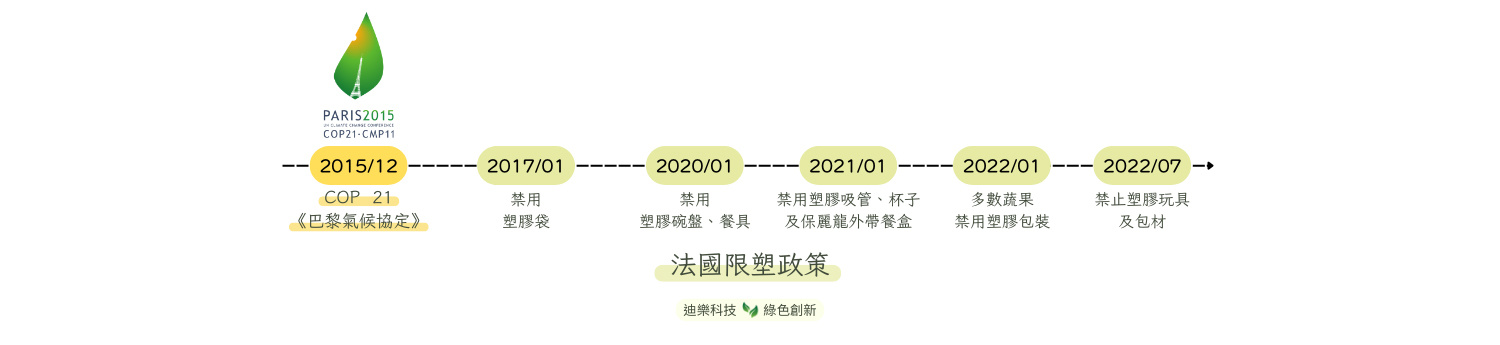
In 2015, as the Kyoto Protocol—signed in Kyoto, Japan—was nearing its expiration, countries convened in Paris, the capital of France, for the 21st United Nations Climate Change Conference (COP 21). There, all 195 participating nations unanimously agreed to adopt the Paris Agreement on Climate Change, aiming to curb accelerating global warming by cutting greenhouse gas emissions. As a landmark climate conference that drew the largest-ever international agreement in environmental history, with participation from leaders of the most countries, France—the host nation—has leveraged the heightened global attention and momentum generated by this event to introduce a series of ambitious anti-plastic policies. These measures aim to tackle one of the key drivers of climate change: plastic pollution—and through concrete actions, France seeks to curb the overwhelming tide of plastic products within its borders. Ultimately, the country aspires to set a powerful global standard and serve as an inspiring model for environmental stewardship worldwide. Leading the World: Actively Formulating Comprehensive Plastic Reduction Policies Following the COP 21 conference, the French government took the lead by passing a new environmental bill in the summer of 2016, officially mandating a nationwide ban on plastic bowls, plates, and cutlery by 2020. Since then, France has introduced one new regulation each year, progressively adding single-use plastic items—such as straws, beverage cups, and polystyrene takeout containers—to the list of prohibited products. The goal is to completely phase out these major contributors to plastic pollution by 2040. In addition to making strides in the most commonly used single-use containers available on the market, the French government also banned the use of plastic packaging for the majority of fruits and vegetables at the start of 2022. This ban covers over 30 items, including vegetables, tomatoes, apples, and more. By promoting the sale of produce unpackaged or by replacing traditional plastic packaging with recyclable, reusable, or biodegradable materials, the initiative aims to cut down annually by roughly 1 billion disposable plastic packages. Furthermore, in the second half of 2022, France intensified its efforts to curb plastic use through multiple measures—such as mandating the installation of water dispensers in public spaces to reduce reliance on plastic bottles—and even going so far as to prohibit fast-food restaurants from providing plastic toys altogether. These actions collectively seek to eliminate plastic from everyday life entirely.
|
|
Under a series of stringent regulations, France has set an unparalleled benchmark for plastic reduction—but at the same time, stakeholders have also voiced concerns about this swift and decisive policy. First, Freshfel Europe believes that the policy was implemented too hastily, raising concerns that the supply of alternative packaging materials may struggle to meet the sharply increasing market demand. Additionally, the current disposal of existing plastic packaging is already facing an awkward predicament. Meanwhile, European packaging manufacturers are worried: while biodegradable bio-plastics appear poised to perfectly replace conventional plastics, their decomposition process actually requires very specific and stringent environmental conditions. Without adequate consumer education, people might mistakenly believe these "biodegradable plastics" are safe for disposal, leading them to carelessly discard such materials—and ultimately causing even more severe plastic pollution. Finally, France’s Minister of Environment noted that although these plastic-reduction measures are well-intentioned, eco-friendly products or packaging generally come at a higher cost than traditional plastic items, potentially placing an additional financial burden on low-income households. |
|
|
Although concerns remain across various sectors regarding the officially announced policies, a closer look at their actual implementation reveals that the French people have demonstrated a highly cooperative attitude, clearly reflecting their strong recognition and consensus on the issue of plastic reduction. Moreover, spurred by these policies, major corporations have begun investing in innovative R&D initiatives—such as using laser technology to engrave labels directly onto the surface of fruits, replacing traditional plastic tags and packaging—or tapping into cutting-edge enzyme research aimed at accelerating or enhancing the efficiency of plastic degradation. If these groundbreaking, forward-thinking solutions bear fruit, they will undoubtedly benefit the entire world, bringing us closer to an even greener, cleaner planet sooner rather than later. France’s unwavering commitment to plastic reduction, coupled with its pioneering policy implementation, leaves no stone unturned in leading the global movement against plastic pollution. By taking the lead themselves, France not only sets a shining example for the world to follow but also empowers nations worldwide to learn from their approach—and ultimately choose the strategies best suited to their own unique circumstances. Together, these efforts will ensure that humanity achieves ultimate victory in this "plastic revolution"! |

Equipment and Tooling
Latest News
Contact Information
Contact Number:+886 2 2658-1018
Taiwan HQ : 11F.-5, No. 408, Ruiguang Rd., Neihu Dist., Taipei City 114752, Taiwan (R.O.C.)
E-mail:service@deluxe-tech.com
Join the “DELUXE GREEN Plant Fiber Alliance”
Want to participate in the mission of 'Greening the World'? Contact us now!
Copyright©2025 Deluxe Technology Group Co., LTD www.300.cn